
News

  • What is the black sludge in the overflow pipe of the kitchen stainless steel sink?
    During daily cooking, food grease, food crumbs, and organic matter left over from washing dishes may flow into the drain pipe through the kitchen stainless steel sink. Over time, these grease and food residues gradually accumulate in the drain pipe.
    2025-02-27
    Learn More
  • Will the waterfall faucet accumulate scale?
    Most waterfall faucets are made of stainless steel, copper, aluminum alloy and other materials. These metal materials have strong corrosion resistance, but they are also easy to absorb minerals in the water. Over time, a thick layer of scale may accumulate on the surface of the faucet, especially in places where the water flow is in contact for a long time.
    2025-02-21
    Learn More
  • Why has my stainless steel kitchen sink turned yellow?
    Water quality is an important factor that causes stainless steel sinks to turn yellow. If the water used in the kitchen sink is hard and contains high minerals or organic matter, when the water flows through the surface of the sink, the minerals are deposited on the surface of the sink, which is easy to form scale.
    2025-02-19
    Learn More
  • How long is the service life of a composite sink?
    The service life of a composite sink is usually 10 to 20 years. Under the premise of high-quality materials, advanced manufacturing processes, and reasonable use and maintenance, it can even reach more than 30 years.
    2025-02-17
    Learn More
  • Can boiling water be poured into a composite sink?
    When boiling water is suddenly poured into the sink, the surface and internal structure of the sink will expand thermally. If the temperature change is too drastic, it may cause cracks, peeling or deformation on the surface of the sink.
    2025-02-14
    Learn More
  • Which kitchen sink has the lowest maintenance cost?
    Stainless steel sinks are the most common type of kitchen sink on the market. They are durable, affordable, and easy to install. They are the first choice for many home and commercial kitchens. Although stainless steel sinks have many advantages, their maintenance costs are relatively low.
    2025-02-12
    Learn More
  • Which kitchen faucet is suitable for a black sink?
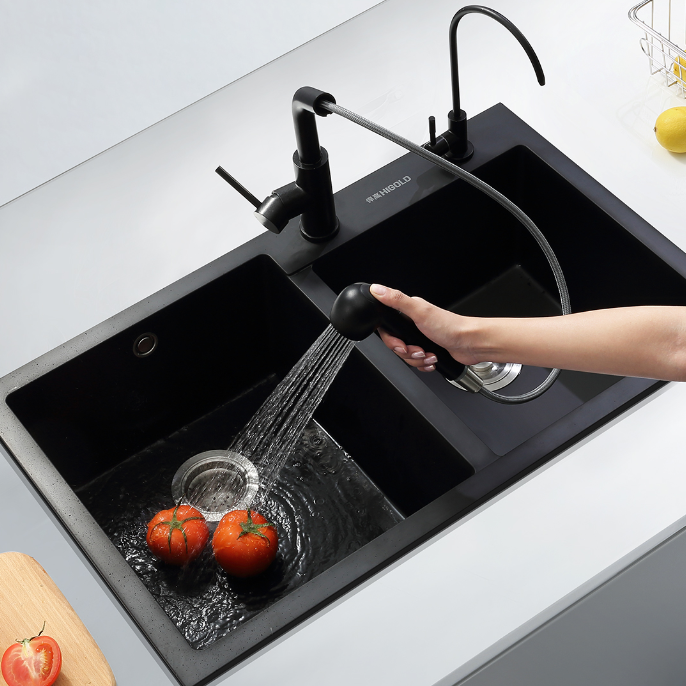
    Stainless steel stretch faucets are usually very flexible. Their retractable design allows users to easily adjust the length of the faucet, making it easier to clean large pots and vegetables. When paired with a black sink, this faucet retains the modern feel of metal while providing an efficient user experience.
    2025-02-11
    Learn More
  • Should the kitchen sink be located in the center of the countertop?
    The space in the kitchen is limited, especially in some smaller apartment kitchens, it is particularly important to reasonably allocate every inch of space. If the sink is placed in the center of the countertop, the kitchen space may be occupied unnecessarily.
    2025-02-10
    Learn More
  • Can a single kitchen sink be converted to a double sink?
    Generally speaking, double sinks need to be at least 32 inches (about 81 cm) or larger in width, while single sinks are usually around 24 inches (about 61 cm) wide. If your kitchen countertop space is not large enough, refitting a double sink may cause serious compression of countertop space and affect other kitchen operations.
    2025-02-06
    Learn More
  • How to tell if a stainless steel sink is 304?
    An important feature of 304 stainless steel is that it is austenitic stainless steel and is usually not magnetic. Although the surface of 304 stainless steel may be slightly magnetic, its magnetism is much lower than that of iron materials. Therefore, testing by magnet method is a simple way to identify whether a 304 stainless steel sink is truly 304.
    2025-02-04
    Learn More

Get the latest price? We will reply as soon as possible (within 12 hours)