
News

  • Why is Stainless Steel Recommended for Undermount Sinks?
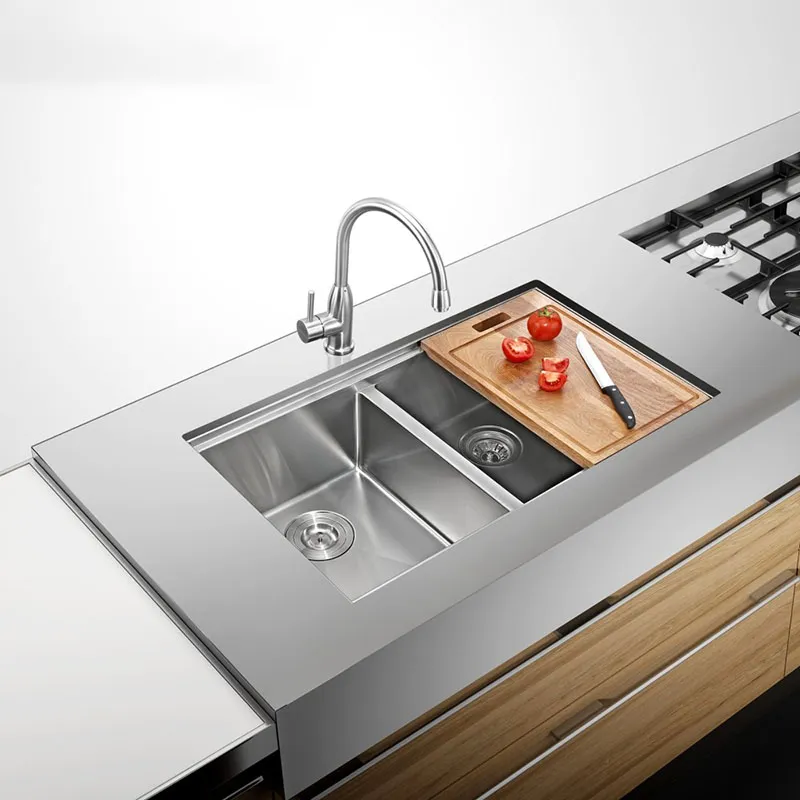
    When choosing an undermount sink, the sink material must be able to withstand the weight, tension, and long-term stress brought about by the suspended installation method. Stainless steel has a natural advantage in this regard, making stainless steel undermount sinks exceptionally stable during installation.
    2025-12-11
    Learn More
  • Which Stainless Steel Sink is the Healthiest?
    304 stainless steel sinks, under normal kitchen conditions, can withstand long-term contact with water, salt, and the acidic and alkaline substances in everyday food without easily rusting. Their smooth surface is easy to clean, making them suitable for most family kitchens and a basic guarantee of a healthy kitchen sink.
    2025-12-09
    Learn More
  • What are the differences between PVD sinks and stainless steel sinks?
    PVD sinks are not a new sink material; they are essentially still stainless steel sinks. PVD refers to a surface coating process, short for Physical Vapor Deposition. This process deposits a layer of metal ion plating on the surface of the stainless steel sink to improve surface color, wear resistance, and corrosion resistance.
    2025-12-08
    Learn More
  • What can I use to clean a stainless steel kitchen sink?
    Daily Cleaning: • Rinse with water • Wipe with a soft sponge and neutral detergent • Rinse thoroughly with hot water • Dry with a microfiber cloth Deep Cleaning: • Sprinkle with baking soda • Spray with white vinegar • Let it sit and scrub • Rinse thoroughly • Dry • Lightly wipe the sink surface with a small amount of stainless steel polish
    2025-12-05
    Learn More
  • What is the PVD coating on 304 stainless steel sinks?
    PVD coating (Physical Vapor Depsosition) is a coating technology that deposits metal or ceramic materials onto the surface of a 304 stainless steel sink in a vacuum environment through physical vaporization, evaporation, or sputtering. This process does not involve chemical reactions, resulting in a high-purity, dense, and strongly adhesive coating.
    2025-12-04
    Learn More
  • Is PVD Coating Better for 304 Stainless Steel Sinks?
    It evaporates a metal target into ions, which are then deposited onto the surface of a 304 stainless steel sink, forming a dense, strong, and corrosion-resistant metal film. This film is very thin, yet possesses extremely high strength and adhesion, significantly enhancing the appearance and performance of the 304 stainless steel sink.
    2025-12-03
    Learn More
  • How to Prevent Water Stains on Stainless Steel Kitchen Faucets?
    To prevent water stains from accumulating on the surface of stainless steel kitchen faucets, wipe the faucet surface dry immediately with a clean, soft cloth after each use, especially areas prone to water residue such as the faucet bends, base, and spout.
    2025-12-02
    Learn More
  • Will stainless steel undermount sinks leak?
    From the perspective of material and structure, stainless steel undermount sinks inherently have good waterproof performance. As long as the sink material is qualified and the sink body has no cracks, it will not leak due to the sink itself during daily use.
    2025-11-27
    Learn More
  • Stainless Steel Sinks vs. Composite Sinks: Which is More Scratch-Resistant?
    If you care about maintaining a perfect surface appearance, composite sinks are more scratch-resistant; If you prioritize impact resistance and long-term stable use, stainless steel sinks are more durable.
    2025-11-25
    Learn More
  • Are scratches on stainless steel kitchen sinks permanent?
    Minor Scratches are Not Permanent Most of the fine scratches seen on stainless steel kitchen sinks are actually minor surface wear. These scratches are typically: • Very shallow • Irregularly distributed • More noticeable when the angle of light changes • Can be faded or even disappeared with appropriate methods
    2025-11-24
    Learn More

Get the latest price? We will reply as soon as possible (within 12 hours)